Case study
IoT Intrusion Detection System (TCNN)
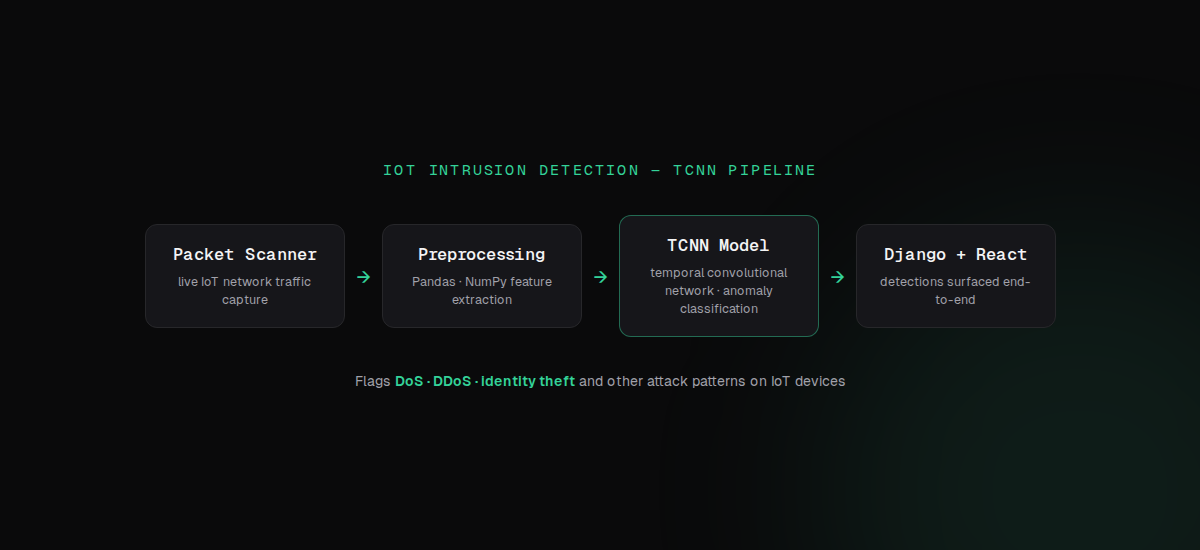
An intelligent intrusion detection system for IoT devices — network traffic captured off the wire, classified by a TensorFlow deep-learning model, and surfaced through a full-stack application.
Problem
IoT devices are easy targets: limited compute, weak defaults, and constant network exposure. Detecting attacks means analyzing traffic patterns and separating real anomalies from normal chatter — on a heavily imbalanced dataset where genuine attacks are rare next to normal traffic, which biases a naive model toward missing them.
Approach
- Live network traffic is captured from IoT devices with Wireshark on Kali Linux and exported as PCAP for analysis.
- Captures are preprocessed with Pandas and NumPy into model-ready numeric and categorical features, with Matplotlib for evaluation and tuning.
- SMOTENC resamples the large, imbalanced dataset — synthesizing minority-class attack samples across mixed numeric and categorical features — so the model is not biased toward the dominant normal traffic.
- A Temporal Convolutional Neural Network (TCNN), built in TensorFlow, classifies network-traffic sequences and flags anomalies.
- A Django REST Framework backend serves the model's detections to a React frontend, with MongoDB for storage — an end-to-end application from capture to alert.
Outcome
- Detected multiple attack classes against IoT devices — DoS, DDoS, identity theft, packet sniffing, and reconnaissance.
- Rebalancing with SMOTENC improved detection of rare attack types that a naive model would overlook.
- Deployed as a working application — capture, detection, and presentation in one system.
Stack
PythonTensorFlowDeep Learning (TCNN)scikit-learnSMOTENCPandasNumPyWiresharkPCAPKali LinuxDjango REST FrameworkReactMongoDB