Case study
Redshift Data Warehouse & S3 Data Lake
Warehouse, lake, and pipelines — the analytical backbone that cut ETL time by up to 70%.
Problem
Analytics needs data from everywhere — operational PostgreSQL, transactional logs, raw CSV files — and slow, ad-hoc ETL keeps business intelligence perpetually behind. The platform needed reliable ingestion and fast queries at scale.
Approach
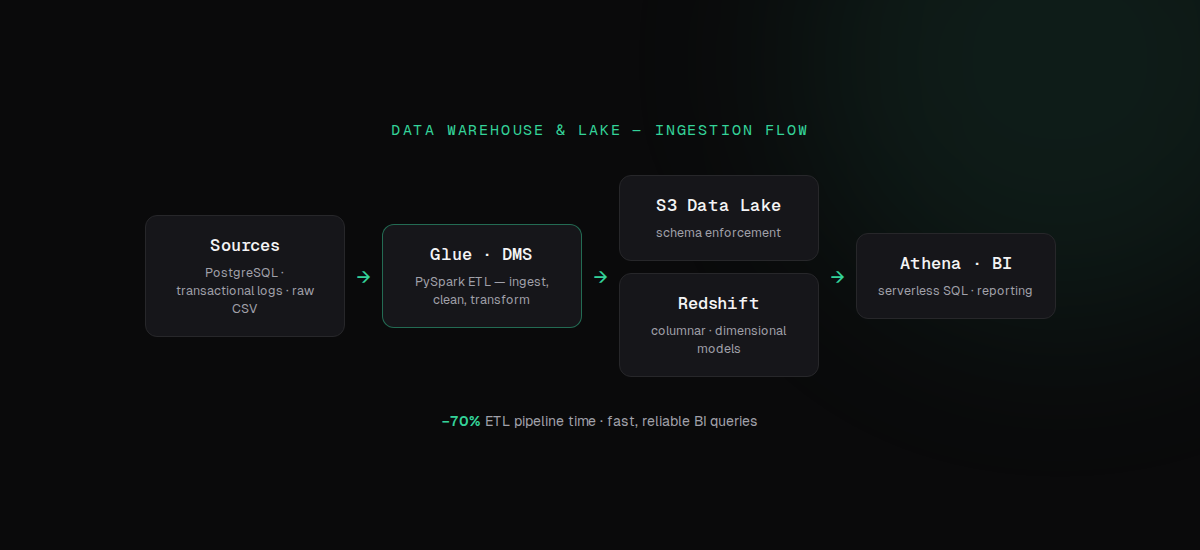
- Amazon Redshift warehouses implement optimized columnar schemas and dimensional data models for high data integrity and fast BI query execution.
- AWS Glue (PySpark) and AWS Database Migration Service pipelines ingest, clean, and transform data from PostgreSQL databases, transactional logs, and raw CSV files.
- An AWS Data Lake on Amazon S3, queried with Amazon Athena, provides serverless SQL, data validation, and automated schema enforcement across disparate datasets.
- Streamlined data discovery and reporting workflows reduce processing overhead for downstream BI consumers.
Outcome
- Large-scale ETL pipeline time reduced by up to 70%.
- Fast, reliable BI query execution on governed, well-modeled data.
- One lake-plus-warehouse architecture serving downstream analytics.
Stack
Amazon RedshiftAWS GluePySparkAWS DMSAmazon AthenaAmazon S3